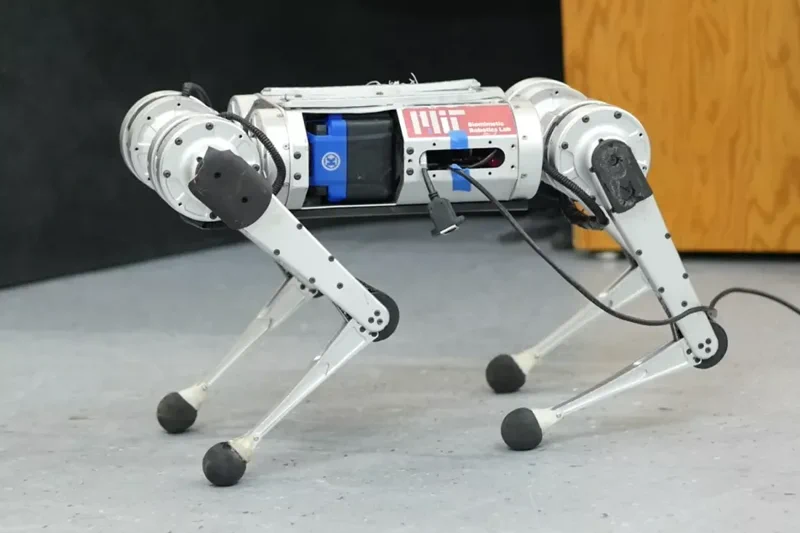
Instead of being micromanaged by rigid lines of code, this MIT-born quadruped learned to find its footing the hard way: through experience. By running through a high-speed “virtual boot camp” in simulation, the robot mastered treacherous terrain in just a few hours, discovering the most efficient ways to move entirely on its own. The result? Blistering speeds across almost any landscape.
MIT’s Mini Cheetah is Now Outrunning its Own Programming
The secret sauce wasn’t a more complex script; it was letting the robot figure out how to run through trial and error, rather than relying on human engineers to hard-code every joint rotation.
As Gabriel Margolis, an MIT PhD candidate, and Ge Yang, a postdoc at IAIFI, explained in a recent interview, the traditional robotics paradigm is a massive bottleneck. Historically, humans have had to tell robots exactly what to do and how to do it. The problem is that this approach doesn’t scale—it takes an agonizing number of man-hours to manually program a robot to handle the infinite variables of the real world.
To break through that wall, the team leveraged the power of simulation and machine learning to accelerate the learning curve.
During its sprint tests, the robot clocked a peak speed of 3.9 meters per second—roughly 8.7 mph. But the real “wow” factor is how it handles the rough stuff, like icy patches or loose gravel. While traditional, human-designed software often sees the robot stumble or face-plant when transitioning from gravel back to solid pavement, this AI-taught version adapts on the fly with a level of grit and grace that hand-written code simply can’t match.
Source: TechSpot