Upcoming Events:July 13, 2026 - July 17, 2026
Location:
About the Event
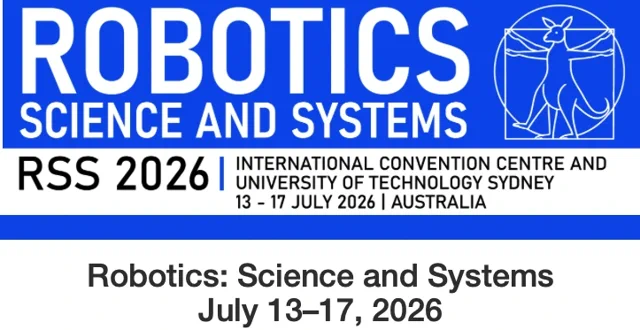
In a world saturated with sprawling, multi-track mega-conferences, Robotics: Science and Systems (RSS) remains a bastion of focused, high-signal academic rigor. Think of it as the robotics equivalent of a Michelin-starred restaurant versus an all-you-can-eat buffet. The 22nd edition of RSS will take place from July 13-17, 2026, bringing the world’s leading robotics researchers down under to Sydney, Australia.
Hosted at the impressive International Convention Centre (ICC) Sydney and the University of Technology Sydney (UTS), RSS 2026 continues its tradition as a premier single-track event. This format is by design, forcing a level of quality and curation that ensures every presentation is worth your undivided attention. There’s no “track-hopping” to escape a dry talk here; if it’s on the schedule, it’s because the program committee deemed it essential. The event is organized by the RSS Foundation, a non-profit run by volunteers dedicated to fostering an open, high-quality scientific discourse in robotics.
This conference is engineered for the deep-end-of-the-pool crowd: PhD students, postdoctoral researchers, academics, and corporate R&D scientists who live and breathe the mathematical and algorithmic foundations of robotics. If your idea of fun is debating the finer points of stochasticity in reinforcement learning or the merits of different SLAM algorithms, you’ll be right at home.
Attendees will leave with a clear-eyed view of where the bleeding edge of robotics research is headed, armed with new ideas and a network of peers who are actually building the future, not just talking about it.
Key Themes
While the final program is still being forged in the fires of peer review, the conference consistently revolves around the core scientific challenges in robotics. Based on past events and current research trends, expect a heavy focus on:
- AI and Machine Learning for Robotics: This is the big one. Expect deep dives into foundation models, reinforcement learning, imitation learning, and how to make robots that can actually generalize from one task to another without setting the lab on fire.
- Perception, Estimation, and SLAM: Making robots that can see, understand, and map their environment is a perennial challenge. Sessions will likely cover everything from novel sensor fusion techniques to building robust, long-term representations of the world.
- Planning, Control, and Dynamics: The science of making robots move with grace, precision, and purpose. This includes everything from complex manipulation and bipedal locomotion to coordinating swarms of autonomous agents.
- Human-Robot Interaction (HRI): As robots move out of cages and into our lives, designing safe and intuitive ways for humans and machines to collaborate is critical. Expect research on both the physical and cognitive aspects of HRI.
- Field Robotics: Taking robots out of the lab and into the wild. This track often features rugged systems designed for agriculture, defense, inspection, and navigating the great, unpredictable outdoors.
Featured Speakers
The official list of keynote speakers for RSS 2026 has not yet been announced. However, the conference has a stellar track record of attracting luminaries from both academia and industry who are at the absolute forefront of the field.
Prospective attendees should keep a close watch on the official Robotics: Science and Systems 2026 website for updates. In addition to keynotes, the program includes an “Early Career Spotlight” and the “RSS Pioneers” workshop, which highlights the work of top emerging researchers in the robotics community.
Provisional Schedule
The detailed day-by-day schedule is still under development. However, the RSS conference typically follows a structured five-day format:
Day 1 & 2 - July 13-14
- Full Day: Workshops and Tutorials
- Evening: Welcome Reception and Poster Sessions
Day 3 & 4 - July 15-16
- Morning: Keynote Address followed by single-track paper presentations
- Lunch: Networking and Poster Sessions
- Afternoon: Single-track paper presentations
- Evening (Day 4): Conference Gala Dinner
Day 5 - July 17
- Morning: Single-track paper presentations and Early Career Spotlight
- Afternoon: Final paper sessions and awards ceremony
- Evening: Conference concludes
Registration
Registration for RSS 2026 is now open, with early bird pricing available for those who act fast. Securing your spot early is highly recommended, not just for the discount but because this is one of the most anticipated events on the academic robotics calendar.
- Register Now on the official RSS 2026 website
- Pricing: Fees are listed in Australian Dollars (AUD). Early bird rates (until May 11, 2026) are:
- Student: $750
- Academic (Postdoc/Researcher/Professor): $1,250
- Industry: $1,550
- Inclusions: Full registration includes access to all conference sessions, workshops, the exhibition hall, daily catering, and tickets to the poster sessions and the Gala Dinner.
- Deadline: Early bird pricing ends May 11, 2026. Prices increase significantly after this date.