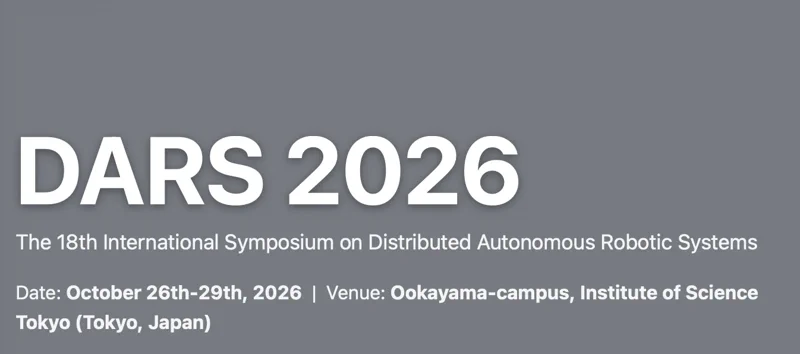
Upcoming Events:October 26, 2026 - October 29, 2026
Location:
About the Event
Forget your lone, brooding automata. The future is a chattering, coordinated, and occasionally chaotic collective. And for those building that future, the pilgrimage to Tokyo for the 18th International Symposium on Distributed Autonomous Robotic Systems (DARS 2026) from October 26-29, 2026, is non-negotiable.
Held biennially since 1992, DARS has carved out a unique niche as the premier single-track meeting for the multi-robot hive mind. That’s right—no parallel sessions to induce decision paralysis or the dreaded feeling you’re missing the real action. Every presentation is a plenary, ensuring the entire community engages with each breakthrough, from swarm dynamics to distributed perception. This format fosters the kind of in-depth discussion that just doesn’t happen in a cavernous, multi-track convention center.
This symposium is a magnet for top-tier academics, post-docs, and PhD students wrestling with the thorny problems of making robot teams actually work in the real world. If you’re designing algorithms for multi-robot motion coordination, grappling with the ethics of human-swarm interaction, or trying to achieve collective embodied intelligence, these are your people. You’ll leave with a brain buzzing with new ideas and a network of collaborators who understand why one robot is never enough.
Key Numbers
While DARS prides itself on quality over quantity, the numbers still tell a compelling story about its legacy and focus:
- 18th Edition: This isn’t some fly-by-night workshop; it’s a long-standing institution in the robotics community.
- 34+ Year History: The symposium has been shaping the field of distributed robotics since its inception in 1992.
- 1 Single Track: Every attendee. Every paper. Every discussion. All in one room for maximum intellectual cross-pollination.
- 2 Prestigious Paper Awards: The intellectual cage match for the coveted Best Paper and Best Student Paper awards ensures only top-tier work is celebrated.
- Dozens of Research Topics: From modular robotics to trustworthy distributed systems, the call for papers covers the entire gamut of multi-robot challenges.
Important Dates
For all the researchers planning their next big submission, mark your calendars. Deadlines are sacred, and the DARS organizers have laid them out with brutal clarity.
| Milestone | Date |
|---|---|
| Paper Submission Deadline | March 20, 2026 (with a grace period until May 1) |
| Notification of Acceptance | July 1, 2026 |
| Late Breaking Results/Demo Submission | August 1, 2026 |
| Camera-ready Papers Due | August 1, 2026 |
| Symposium Dates | October 26-29, 2026 |
Venue & Getting There
DARS 2026 will be hosted at the Ookayama Campus of the Tokyo Institute of Technology (Tokyo Tech), a hub of scientific innovation in the heart of one of the world’s most dynamic cities. The campus is conveniently located and easily accessible.
- Address: 2 Chome-12-1 Ookayama, Meguro City, Tokyo 152-8550, Japan.
- Transport: The campus is a one-minute walk from Ōokayama Station, served by the Tokyu Oimachi and Tokyu Meguro lines. This provides straightforward connections from major transport hubs like Shinagawa, Meguro, and Oimachi stations, as well as both Haneda (HND) and Narita (NRT) airports.
Attendees will find a wide range of accommodation options in nearby districts such as Meguro and Shibuya, offering everything from luxury hotels to budget-friendly stays, all just a few train stops away.
Key Themes
The symposium invites papers on all facets of getting robots to play well with others. Expect deep dives into:
- Swarm Robotic Systems: Because one robot is lonely, and a thousand are a logistical nightmare we’re here to solve.
- Multi-robot Motion Coordination: Choreographing the intricate dance of dozens of machines without them crashing into a pile of very expensive scrap.
- Collective Embodied Intelligence: Exploring how a group of simple robots can exhibit complex, intelligent behavior, proving the whole is scarier—I mean, smarter—than the sum of its parts.
- Human-Swarm Interaction: How do you safely and effectively command an army of autonomous agents without a T-1000 on your hands?
- Modular and Self-Assembling Systems: Robots that build themselves and each other, which is not at all terrifying.
- Distributed Perception and Planning: Giving robot teams a shared understanding of their world and a coherent plan of attack.
Awards and Recognition
While DARS doesn’t feature robot sumo wrestling (a tragic oversight, in my opinion), the intellectual competition is fierce. The symposium recognizes outstanding contributions through two main accolades:
- Best Paper Award
- Best Student Paper Award
Winning one of these is a significant mark of distinction in the field, recognizing research that is not only original but also impactful for the future of distributed autonomous systems.
Featured Speakers
The official lineup of keynote and plenary speakers for DARS 2026 is still under wraps. However, if history is any guide, attendees can expect to hear from the titans of the field. Past editions have featured luminaries from world-class institutions like MIT, Harvard, and EPFL, setting a high bar for the 2026 program. Check the official DARS website for announcements as the dates draw nearer.
Exhibition & Industry
While primarily an academic affair, DARS provides a forum for sponsors and exhibitors to connect with leading researchers. The exhibition will likely feature companies and labs showcasing the cutting-edge hardware, sensors, and simulation platforms that power the next generation of multi-robot systems.
Travel Grants & Funding
Information on travel grants and student funding opportunities has not yet been released. Typically, academic conferences of this caliber offer support programs for students and researchers to help defray the costs of attendance. Aspiring attendees are encouraged to monitor the official DARS 2026 website for updates on eligibility and application deadlines.
Schedule
The detailed day-by-day program will be released closer to the event. However, attendees can expect a packed four-day, single-track schedule running from October 26th to 29th, 2026. The program will be composed of intensive technical sessions for paper presentations, ample time for Q&A, and dedicated networking events. A “Late Breaking Results & Demo” session will also provide a platform for the very latest findings.
Registration
Registration for DARS 2026 is not yet open. Pricing and tier information are expected to be announced on the official symposium website. Based on past events, expect tiered pricing for students, regular attendees, and potentially members of affiliated professional societies.
Keep an eye on the official DARS 2026 registration page for the latest updates. For any specific questions, you can reach out to the organizers at [email protected].