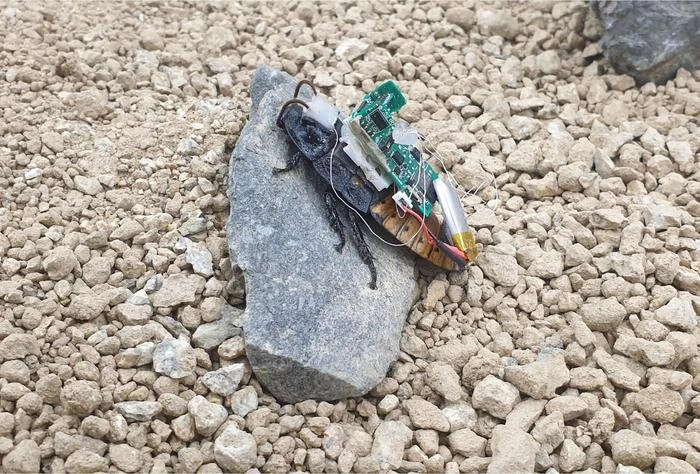
Just when you thought 2026 couldn’t get any stranger, scientists have gone and strapped AI-powered rucksacks to living cockroaches, creating a biohybrid system that navigates treacherous terrain with a level of efficiency that is as impressive as it is slightly unsettling. A joint research team from Osaka University in Japan and Universitas Diponegoro in Indonesia has developed what they’re calling “biohybrid physical AI”—a system that is smart enough to know exactly when to step back and let a cockroach be a cockroach.
Published in the August 2026 issue of the journal Device, the research details a setup where a live Madagascar hissing cockroach is equipped with a miniature backpack containing sensors and a multilayer perceptron—a specific type of AI. This AI module processes data from onboard sensors to classify the surrounding environment in real-time, distinguishing between flat ground, inclines, declines, and pitfalls with a reported 92% accuracy. While previous iterations of cyborg insects were essentially remote-controlled puppets, this new AI-driven approach knows when the insect’s own instincts are better suited for the task at hand.
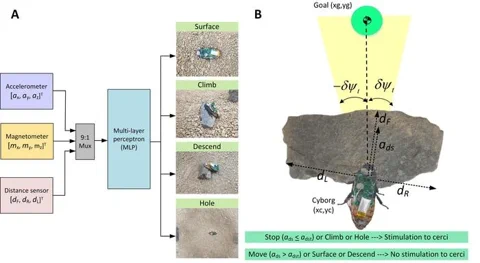
The real breakthrough here is “reactive climbing.” When the AI recognises that the cockroach is attempting to scale an obstacle, it dials back the electrical steering stimulation. This allows the insect’s natural, evolved climbing abilities to take over, preventing the hesitation and clunky movement often seen when a digital controller tries to micromanage every step. The result is a much faster, more fluid route across complex surfaces. For those wanting to dive into the technicalities, the full paper is titled “Biohybrid navigation through real-time terrain recognition and natural climbing in cyborg insect.”
Why does this matter?
This is far more than just a high-tech science fair project. The ultimate goal is to deploy highly mobile, low-power agents for critical tasks like search-and-rescue operations in disaster zones. In environments where rubble and tight spaces make traditional robots redundant, these tiny, resilient explorers could be literal lifesavers. Rather than trying to build a complex microrobot from scratch, this method hijacks millions of years of evolution and adds an AI co-pilot. As Professor Keisuke Morishima of Osaka University explains, the research could “inspire the development of robotic systems capable of operating in complex environments.” It represents a subtle but vital shift from simply remote-controlling an organism to creating a truly cooperative partnership between artificial intelligence and natural instinct.