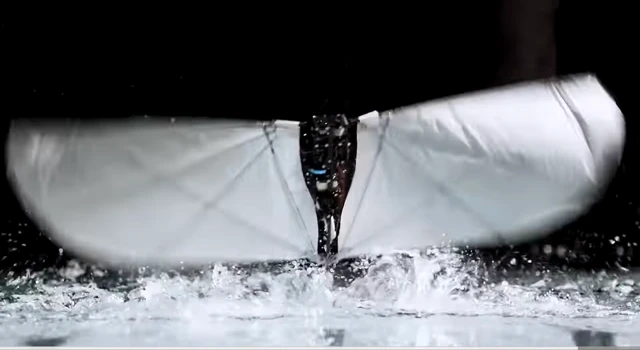
Researchers at MIT and Switzerland’s EPFL have cracked one of robotics’ most stubborn nuts: a machine that flies and swims with the effortless grace of a seabird. Eschewing the noisy brute force of traditional propellers, this new Flapping-wing Aerial Aquatic Vehicle (FAAV) takes its cues from the puffin, flapping its way through both air and water. Even more impressive? It can breach the surface and transition back into flight—a manoeuvre that has left engineers scratching their heads for years.
The core headache is the sheer density gap between air and water; what works for a breeze is usually useless in the brine. While nature’s puffins cleverly fold their wings to dive, the researchers opted for a mechanically elegant “flex-wing” design. This allows the robot to beat its wings at a frantic 10 Hz in the air, then switch to a leisurely 1 Hz stroke underwater, all driven by the same motor system.

Breaking free from the surface tension is the real kicker—described as the most “energy-intensive part of the entire cycle.” The team discovered that the secret sauce is a 70-degree exit angle; anything else and the bot fails to regain its wings. To avoid the “lead balloon” effect of a heavy waterproof casing, the researchers individually waterproofed every electronic component. It’s a brilliant bit of lateral thinking that keeps the craft light enough to fly and “neutrally buoyant” by default.
Why does this matter?
Propeller-driven drones are a bit of a nuisance in sensitive environments; they’re loud, and those high-speed blades are a liability near fragile ecosystems. A flapping-wing bot is the “stealth” alternative—quieter, safer, and far less disruptive. The creators envision a future where a scientist could carry one of these in a rucksack, deploy it from the shore, fly it to a specific GPS coordinate, and have it dive for a water sample before flying home. It’s a low-impact, high-tech solution for environmental monitoring that bridges the gap between the sky and the sea in ways traditional robots simply can’t.