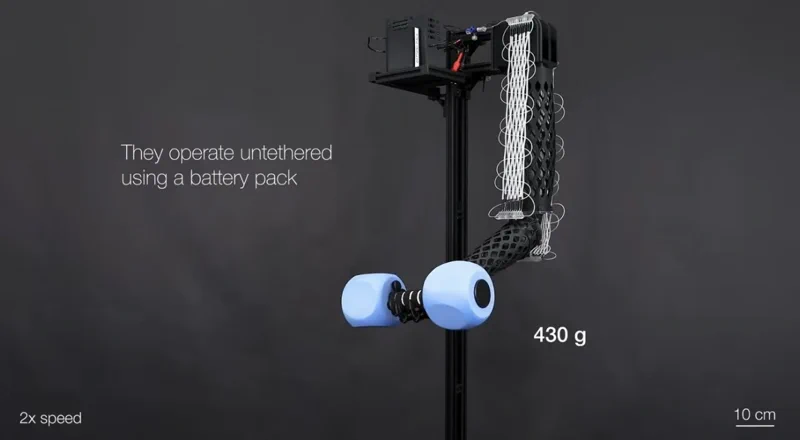
Researchers at the École polytechnique fédérale de Lausanne (EPFL) have cooked up a technology that feels like it’s been plucked straight from the pages of a William Gibson novel: artificial muscle fibres that can be woven directly into everyday clothing to create a soft, wearable exoskeleton. These Electrofluidic Fibre Muscles aren’t just a bit of clever kit—they are remarkably powerful, with bundles capable of hoisting 200 times their own weight, all while remaining silent, flexible, and entirely machine-washable.
The real stroke of genius here is the integration of flexible, millimetre-scale pumps directly into the fibres themselves. Rather than relying on the sort of clunky, noisy compressors that usually power contemporary soft robotics, these fibres use electric fields to shunt fluid around via a process known as charge-injection electrohydrodynamics (EHD). This self-contained setup generates an impressive power density of up to 50 W/kg—a figure that puts it on par with human skeletal muscle—without the need for external hardware, whirring motors, or vibrating parts.
The fibres, which are roughly 2 millimetres thick, are essentially miniature, self-powered hydraulic systems. By bundling or weaving them into a garment, designers can create textiles that offer active muscular support, haptic feedback, or even thermoregulation. The original research, published in the journal Science, showcases the system’s potential across a staggering array of use cases. You can dive into the full paper here: Electrofluidic fibre muscles for untethered and silent robotics.
Why does this matter?
This technology represents a massive paradigm shift in the world of wearable robotics. For years, the dream of a functional exoskeleton has been weighed down—quite literally—by the necessity of rigid frames and loud, power-hungry pneumatic systems. The EPFL fibre pumps effectively bin that entire layer of complexity, embedding the actuation mechanism directly into the fabric of the suit.
The implications are wide-reaching. We’re looking at the potential for lightweight, comfortable exosuits that assist patients with mobility issues during rehab, or workwear that takes the literal weight off the shoulders of those in physically demanding jobs. Because the fibres are silent and discreet, the tech could easily migrate into the consumer space, powering haptic suits for immersive VR or “smart” apparel that subtly boosts the wearer’s natural strength. It’s the difference between strapping yourself into a machine and simply putting on a shirt that makes you feel superhuman.