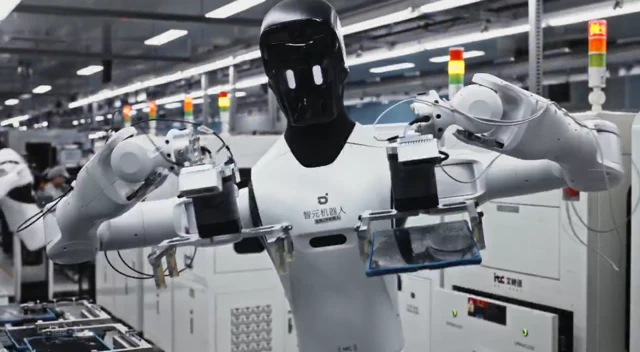
The long-promised, often-mocked future of humanoid robots punching the clock on the factory floor has officially moved past the “coming soon” phase. Chinese robotics outfit AGIBOT and electronics manufacturing titan Longcheer Technology have deployed a fleet of AGIBOT G2 humanoids onto a live consumer electronics production line. This isn’t just another glossy marketing reel; it’s a full-scale industrial application of what the companies are dubbing “Physical AI.”
The wheeled G2 humanoids are currently stationed on Longcheer’s tablet production lines, tasked with the precision-heavy work of loading and unloading at testing stations. According to reports, the integration took a mere four months, and the robots are already operating around the clock, smashing their key performance targets. To silence the sceptics, a live-streamed event showed a G2 robot pulling a full eight-hour shift, processing 310 units per hour with a claimed success rate of over 99.5%.
For those not in the loop, Longcheer Technology is a massive, under-the-radar Original Design Manufacturer (ODM) that builds hardware for global heavyweights like Samsung, Xiaomi, and Lenovo. Partnering with a firm of this magnitude gives AGIBOT the kind of immediate, real-world validation that most robotics startups can only dream of. The roadmap is ambitious, with plans to scale the deployment to 100 robots by the third quarter of 2026.
The AGIBOT G2 is a serious bit of industrial kit. It features dual 7-DoF arms equipped with force control for delicate manoeuvres, 26 total degrees of freedom, and a wheeled base designed to navigate busy factory floors with ease. Crucially for high-volume manufacturing, it supports 24/7 operation thanks to hot-swappable batteries—a must-have feature for minimising downtime.
Why does this matter?
This deployment marks a pivotal shift from choreographed lab demos to the gritty, high-stakes reality of a mass-production environment. While other players in the space are still polishing their prototypes, AGIBOT and Longcheer are generating actual production data and, crucially, economic value. This move puts immense pressure on the rest of the humanoid sector. It proves that the technology is no longer just a “cool concept” for manufacturing—it’s ready for the big leagues. The era of humanoid robotics just got a lot less theoretical and a lot more productive.