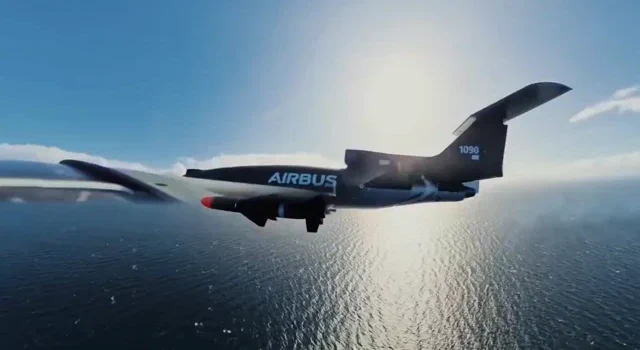
It seems Airbus has finally had enough of the frankly absurd economics of modern air defence, where multi-million-pound missiles are routinely deployed to knock out drones worth less than a second-hand banger. The aerospace giant has just unveiled its counter-move: a reusable hunter drone that packs its own arsenal of pint-sized, low-cost missiles. Dubbed the Bird of Prey, the system bagged its first air-to-air kill during a maiden demonstration flight in Germany.
The news broke via a post on X from Boris Alexander Beissner, a department head at Airbus Defence and Space, who pointed out that the project went from the initial kickoff to its first successful intercept in a blistering nine months. The Bird of Prey is a modified Do-DT25 target drone—a 160kg platform with a 2.5-metre (approx. 8ft) wingspan—that has been cleverly repurposed from being missile bait to being the one pulling the trigger.
During the trial, the drone autonomously tracked and engaged a kamikaze target drone using a “Frankenburg Mk1” missile. These ultra-light interceptors, developed alongside partner Frankenburg Technologies, weigh less than 2kg each and are just 65cm long. While the prototype carried four missiles, the plan for the final version is to double that capacity to eight. Each “fire-and-forget” missile has an engagement range of roughly 1.5km (just under a mile) and utilises a fragmentation warhead to neutralise threats.
Why does this matter?
The current cost-exchange ratio in drone warfare is, quite simply, unsustainable. Launching a Patriot missile, which can set you back upwards of £3 million, to take down a £15,000 drone is a strategy that leads straight to empty coffers and depleted stockpiles. The Bird of Prey system is designed to flip that script entirely. By utilising a reusable, relatively cheap drone to launch mass-produced interceptors, Airbus is building a scalable shield against the rising threat of drone swarms. It’s less like using a sledgehammer to crack a nut and more like training a falcon to do the job for you—efficiently, repeatedly, and without bankrupting the treasury. Airbus and Frankenburg are planning further trials throughout 2026 to get the system ready for the front line.