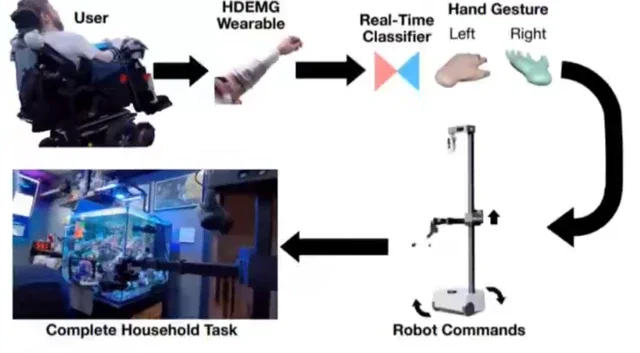
In a development that feels like it’s been lifted straight from the pages of a sci-fi script, researchers from Hello Robot Inc. and Carnegie Mellon University have unveiled a system that allows people with quadriplegia to command a robotic assistant using little more than their thoughts and lingering muscle signals. A recent 12-day trial in a domestic setting proved the system’s mettle, enabling users to direct a robot to fetch a glass of water, grab a snack, and handle daily chores—all without the need for invasive brain surgery.
The system employs a clever dual-track approach. First, it uses high-density electromyography (EMG) to pick up the faint electrical whispers in muscles, even those stilled by paralysis. Second, it pairs this with a non-invasive electroencephalography (EEG) headset that reads brain activity directly from the scalp. During the trial, participants successfully steered a Hello Robot Stretch—a mobile manipulator known for its slender frame and telescoping arm—to pour drinks, fetch clothes, and even pull back a duvet. The Stretch robot is particularly well-suited for this, designed to navigate the cluttered, “lived-in” reality of a typical home.
Why does this matter?
While high-profile brain-computer interfaces (BCIs) involving surgical implants—such as those being pioneered by Neuralink Patient Controls Virtual Hand With Thoughts —tend to hog the limelight, the real hurdle for most is the prospect of going under the knife. This research offers a compelling, non-invasive alternative that could be both more affordable and far less daunting for the end user. It’s a massive leap toward handing back independence and dignity to those with severe motor impairments.
The long game here is even more ambitious. If a simple EEG headset can manage a mobile arm for household faff, the next logical step is scaling that interface to a full-blown humanoid, as we’ve seen in other developments like Mind-Controlled Humanoid Robot Turns Pages, No Brain Surgery Required . Theoretically, a person could navigate their entire day through a robotic proxy, from tackling the stairs to grabbing a cold beer from the fridge. According to the research paper—which carries a publication date of 2602, suggesting it might have arrived via a rift in the space-time continuum—the potential is effectively limitless. Read the paper on arXiv.