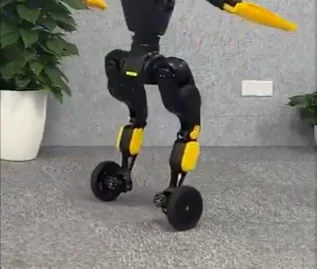
Just when you thought the robotics market couldn’t get any more packed than a Tube train at rush hour, a fresh-faced contender named Zeroth has burst onto the scene at CES 2026. They’ve promptly opened pre-orders for a duo of bots sporting eye-wateringly competitive prices, with shipping slated for April 15, 2026. The lineup features the M1, a diminutive humanoid assistant for a frankly astonishing $2,399, and the W1, a rugged cargo carrier that’ll set you back $4,999.
The M1 is a 494mm (19.4-inch) tall marvel of “embodied intelligence,” apparently designed for home companionship and a bit of light assistance. It navigates with the grace of a particularly determined pigeon, offering a choice between bipedal walking (at a rather leisurely 0.05 m/s) and a sprightlier wheeled mode (0.6 m/s). Zeroth has loaded it up with a rather fetching array of sensors, including LDS LiDAR for mapping, an iTOF depth sensor, and vision cameras, all presumably to ensure it remains a helpful, non-threatening presence – no Skynet scenarios in your living room, thank you very much. With a two-hour runtime and a snappy one-hour fast charge, it’s clearly aiming to carve out a niche in the burgeoning domestic market.

Its stablemate, the W1, is less about a nice cuppa and a chat, and more about the heavy lifting. This compact, tracked robot is built for following its owner, shlepping a 20kg (44 lbs) payload, and even pulling up to a respectable 50kg (110 lbs). It’s essentially a veritable beast of burden that handily doubles as a mobile power station, dishing out up to 120W of output from a USB-C port. Powering the W1 is an 8-core Horizon Sunrise Series CPU, a processor line from Horizon Robotics typically found in edge AI and automotive applications, which rather suggests a laser focus on efficient, real-world navigation.

As if two weren’t enough, Zeroth is also teasing a full-size humanoid named Jupiter, complete with a rather chunky $89,999 price tag. This is a clear declaration that the company has ambitions far beyond the consumer-grade market, with eyes firmly on the industrial prize.
Right, so what’s the big deal?
In a world where humanoid robots from established players are either perpetually “coming soon” or demand a king’s ransom – anywhere from $90,000 to a quarter of a million dollars – Zeroth’s pricing is, to put it mildly, utterly brass-necked. The sub-$3,000 price point for the M1 humanoid, while admittedly for a much smaller and less capable machine, is a punch straight to the gut of established pricing norms. It suggests a daring strategy focused on capturing a mass market early, betting that hardware commoditization can leave the high-end competition choking on its digital dust. The million-dollar question, as always, will be whether the software and real-world utility can truly deliver the goods where it counts: beyond the flashy price tag.