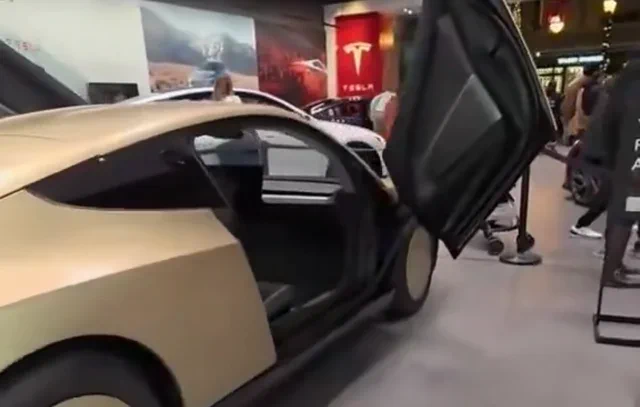
Just when you thought the tech world’s most deliciously bizarre rivalry couldn’t possibly get any weirder, Tesla, Inc. has decided to practically pitch a tent with its vision of the future right on Apple, Inc.’s hallowed turf. A shiny, far more production-ready version of the Tesla Cybercab has been spotted on public display, not just at the company’s Santana Row showroom in San Jose, but also making a cheeky guest appearance at the Apple Visitor Centre in Cupertino. This isn’t the rough-around-the-edges concept we’ve seen before; the vehicle on display boasts numerous refinements, all pointing to a design that’s practically ready for the factory floor.
This updated Cybercab showcases a host of subtle, yet genuinely significant, changes. Keen-eyed observers have clocked a new frameless window design, a more refined front bumper, production-spec lighting, and even two windscreen wipers instead of the prototype’s rather lonely single blade. Inside, the minimalist two-seat cabin appears far more polished, complete with a redesigned dashboard, updated materials, and potentially more legroom, all while conspicuously lacking a steering wheel or pedals. These refinements strongly suggest Tesla is moving well beyond the concept phase and is instead tooling up for its ambitious, driverless future.
The choice of venues is, to put it mildly, absolutely brilliant. The Santana Row showroom is, of course, entirely logical – a home-turf reveal for the loyalists and the merely curious. The Apple Visitor Centre, however, is a masterclass in either corporate mischief or a very public declaration of war. Given the long-simmering rumours of Apple’s own now-defunct automotive project, parking the Cybercab squarely on its rival’s doorstep is a bold move that speaks volumes about Tesla’s confidence in its autonomous strategy, even as the timelines for true self-driving remain characteristically optimistic.
Why Is This Important?
This public debut is Tesla’s rather emphatic way of making its robotaxi network feel tangible after what feels like eons of promises. By showcasing a near-production vehicle, the company is expertly shifting the narrative from abstract software updates to solid, physical hardware, signalling to investors and competitors like Waymo that its purpose-built autonomous vehicle is truly imminent. The stunt at Apple’s headquarters is more than just corporate theatre; it’s a declaration that while one tech giant has reportedly exited the automotive race, another is flooring the accelerator on a future where you don’t own a car, you simply summon one.