In the world of robotics, progress often feels like a slow, stately dance, measured in years and punctuated by meticulously choreographed lab demos and cautious pilot programmes. Then along come Nucleus, a German startup that’s just gatecrashed the whole affair, announcing they’ve deployed humanoid robots into a proper factory in under 90 days. Their approach is so refreshingly, almost impudently, pragmatic it borders on heresy, particularly for a company hailing from Europe’s famously meticulous manufacturing heartland.
Helmed by founder Melvin Schwarz and a crack team of alumni from robotics heavyweights like 1X, Agile Robots, CERN, and the European Space Agency, Nucleus is skipping the long, arduous march to full autonomy. Instead, they’re getting robots to work now, leveraging large-scale human supervision and AI agents to ensure productivity from day one. Their product isn’t a robot at all; it’s “physical work, ‘getting the job done’,” billed by the hour. It’s a bold, perhaps even desperate, gambit to tackle Europe’s dwindling industrial might head-on.
The Data is the Real Endgame
While other companies are still chasing the holy grail of perfect, unsupervised AI in sterile labs, Nucleus is playing a rather cleverer game. Their core belief is that the most valuable asset in the coming age of embodied AI won’t be another large language model, but proprietary, real-world data gleaned from complex, messy environments. As Schwarz himself puts it, they are creating “the long-tail dataset that cannot be scraped or simulated.”
This is the classic data network effect, only this time it’s got boots on the ground. By deploying a supervised fleet today, Nucleus is hoovering up an enormous corpus of interaction data straight from actual factory floors. Every task a human tele-operator guides a robot through, every exception handled, every object manipulated – all of it becomes a crucial training example for a future, more autonomous system. They are, in essence, getting paid by customers to build a data moat that their lab-bound rivals simply can’t bridge.
“Industrial customers want to employ robots, not learn how to deploy them,” Schwarz stated in his announcement. “And this is why we built Nucleus.”
This “deploy now, perfect later” philosophy is a direct gauntlet thrown down to the rest of the industry. While others simulate, Nucleus executes. While others are still penning whitepapers, Nucleus is forging a physical-world dataset that could become the bedrock for a truly general industrial AI.
From Off-the-Shelf Hardware to Factory Floor Realities
To move at such a clip, the company started with the Unitree G1, a humanoid platform known for its affordability—a bit of a steal at around $13,500 for the base model—and agility. It was a no-brainer for a team focused on rapid iteration and deployment over bespoke hardware perfection. Schwarz notes the G1 was ideal for initial testing, but they’ve already upgraded to a more industrial-grade humanoid to handle heavier payloads – a clear sign that Schwarz’s team hasn’t been hanging about in their breakneck development.
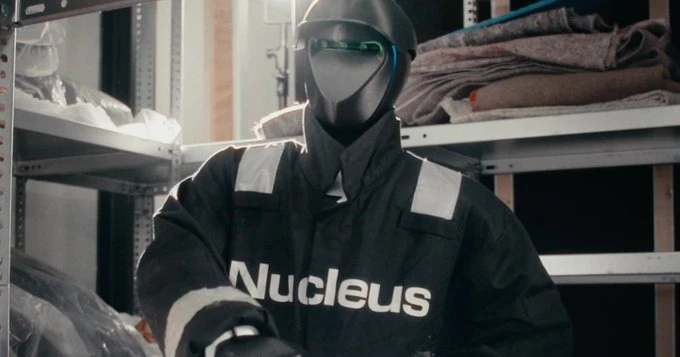
And what about that slightly daft-looking, firefighter-style get-up the robot is sporting? It’s not exactly haute couture. It’s a masterclass in sheer practicality. The suit is a simple, effective solution to meet strict European workplace rules, providing water, scratch, and dust resistance. It’s a tangible symbol of the Nucleus ethos: don’t re-engineer the world for the robot; make the robot work in the world as it is.
A German Startup with a Silicon Valley Metabolism
Schwarz freely admits that the company’s “move at light speed” mentality is “very unusual for Germany.” This cultural departure isn’t just about quirks; it’s central to their mission. Europe’s manufacturing sector is facing a proper demographic crunch. One UN analysis predicts the continent could lose 95 million workers by 2050, with Germany set to be one of the hardest hit. Meanwhile, nearly 40% of European manufacturers already report that labour shortages are limiting production.
Against this rather grim backdrop, Nucleus’s urgency isn’t just understandable; it’s bloody essential. They aren’t simply building a robotics company; they’re attempting a high-speed intervention to prop up an entire continent’s industrial base. By providing “labour as a commodity,” they offer a scalable solution to a problem that demographic trends will only exacerbate.
While the tech world remains mesmerised by the promise of AGI, Nucleus is on the factory floor, billing by the hour and quietly building what might just be the most valuable asset of all: real-world experience. They’ve finished their 90-day sprint and are now well into day 91. For European manufacturing, and frankly, the whole robotics game, this could well be the opening salvo of the endgame.