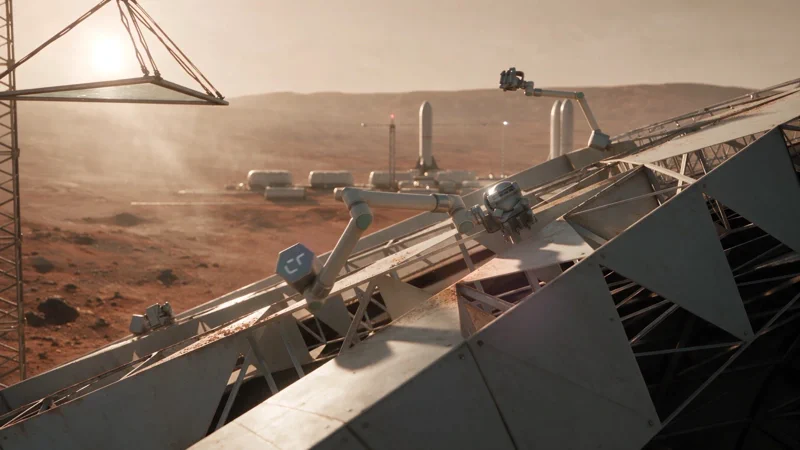
In the grand tradition of tech firms making audaciously bold promises, one startup has decided that merely disrupting terrestrial industries is a bit too “down to earth”. Cosmic Robotics, a Y Combinator alum, has officially tossed its high-vis vest into the ring for the Red Planet, unveiling a comprehensive roadmap to break ground on a Martian city by the mid-2030s. The best bit? The initial construction crew won’t require oxygen, rations, or a therapist to cope with the 22-minute communication lag. They are, of course, entirely robotic.
While Elon Musk is preoccupied with building the interplanetary coach service via SpaceX, Cosmic Robotics is positioning itself as the lead contractor for when the passengers actually arrive. The company’s mission, delivered with a remarkably straight face, is “to build a city on Mars.” This isn’t just a fever dream scribbled on a pub napkin; it’s a calculated strategic play from a firm already deploying heavy-duty autonomous machinery across the UK and US, currently working under contract with NASA for lunar construction. This isn’t their first rodeo—it’s just their first one on another planet.
From Solar Farms to Martian Plains
Before you dismiss this as yet another case of Silicon Valley hubris, it’s worth looking at what Cosmic Robotics is actually achieving today. Their flagship machine, the 4.5-tonne Cosmic-1, is currently grafting on some of the largest solar farms in the United States. This autonomous beast manhandles 40kg solar panels, positioning them with millimetre precision regardless of heat, rain, or snow. According to reports, it has more than doubled the productivity of human crews. They are also moving into the construction of the sprawling data centres that underpin our terrestrial cloud.
This Earth-bound experience forms the bedrock of their Martian gambit. Founders James Emerick (formerly of Built Robotics) and Lewis Jones (an alum of SpaceX, NASA JPL, and Relativity Space) argue that the bottleneck for space exploration is no longer the rockets themselves. The real headache is what you do once you land. Who is going to pour the foundations, bolt together the habitats, and roll out the power grids? Their solution is a fleet of increasingly sophisticated robots, field-tested on Earth’s most punishing construction sites before being craned into a Starship.
The company’s logic is refreshingly straightforward: if you can automate the build of a data centre in the sweltering Texas heat, you have a solid starting point for erecting a habitat on a planet where the mercury regularly hits -60°C.
The Interplanetary Project Manager
Cosmic Robotics’ roadmap isn’t a vague wish list; it’s a phased assault. It starts with the systems they are deploying right now and iterates them for the vacuum of the Moon and the dust of Mars. The core challenge they’ve identified is labour—or the total lack of it. A city requires manufacturing, infrastructure, and agriculture, none of which can be bootstrapped by a handful of brave astronauts with shovels. Robots are the only way to scale.
The plan relies on developing a suite of autonomous machines capable of:
- Site Preparation: Clearing and levelling terrain—a task significantly more fraught on an alien world with mystery soil and zero GPS.
- Infrastructure Deployment: Laying down power systems, massive solar arrays, and basic road networks.
- Habitat Construction: Assembling and hermetically sealing pressurised structures to shield humans from the thin CO2 atmosphere and lethal cosmic radiation.
The primary hurdle, physics aside, is autonomy. With a comms delay of up to 24 minutes each way, you can’t simply “joystick” a robot from a desk in Milton Keynes. These machines must be “self-aware” enough to solve problems on the fly, whether that’s navigating an unexpected crater or diagnosing their own mechanical gremlins.
A New Ecosystem is Taking Shape
The rise of outfits like Cosmic Robotics signals a vital maturation of the commercial space sector. It’s no longer just about the “launch” billionaires. An entire ecosystem is emerging to handle the “what next?” phase of exploration. While NASA focuses on the hard science and SpaceX perfects the celestial logistics, a new tier of specialists is tackling the gritty, unglamorous work of off-world infrastructure.
This isn’t so much a rivalry with SpaceX as it is a symbiotic partnership. Musk needs someone to build the Martian suburbs his colonists will live in. Cosmic Robotics needs a reliable heavy-lift ride to get their 4.5-tonne machines to the site.
Naturally, the path to a Martian metropolis is littered with gargantuan engineering obstacles, from corrosive, perchlorate-laced dust to the nightmare of powering heavy kit during planet-wide dust storms. But Cosmic Robotics is making a calculated bet: that the hardest problems of off-world construction can be solved right here on Earth, one solar panel at a time. If they’re right, the first Martian homeowners won’t be thanking a pioneer—they’ll be thanking a robot.