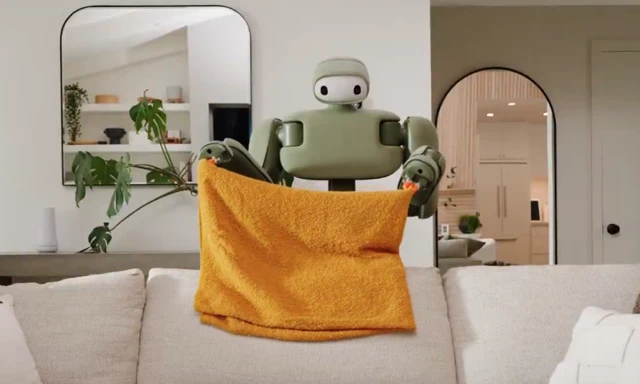
The robot butler, we’ve been told for decades, is perpetually five years away. Yet, another contender has entered the fray, promising to liberate you from the soul-crushing monotony of household chores. Meet Isaac 1 from Weave Robotics, a wheeled humanoid designed to tackle your laundry, make your bed, and generally sort out the mess you call a living room. It’s sleek, comes in muted tones like “Sage” and “Terracotta,” and represents a very specific bet on what the first successful home robot will actually look like.
This isn’t some fresh-faced startup’s vaporware. Weave, a Y Combinator-backed outfit, has already been cutting its teeth with Isaac 0, a stationary laundry-folding robot that has been shipping to customers in California for months. That earlier model—essentially a torso bolted to a table—has reportedly been folding over 450kg of laundry every week, giving Weave a crucial foothold in the chaotic reality of actual homes. Now, with Isaac 1, the company is untethering its creation and giving it wheels.
From Stationary Folder to Mobile Tidier
The leap from Isaac 0 to Isaac 1 is significant. While its predecessor was a one-trick pony focused solely on folding clothes placed before it, Isaac 1 is mobile and far more versatile. Its advertised skills fall into two main categories: “Laundry Flow” and “Daily Reset.” This means it can now track down and pick up dirty clothes, handle hampers, and put clean laundry away. Beyond the utility room, it promises to make your bed, fluff pillows, and clear the daily clutter of shoes, toys, and whatever else you’ve left strewn about.
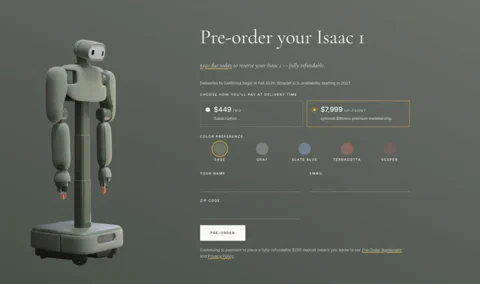
To pull this off, Isaac 1 stands on a wheeled base and can adjust its height from a compact 3ft to a full 5ft 9in. It boasts an eight-hour battery life with a two-hour charge time, which seems just about spot on for a day’s worth of tidying. However, instead of complex, five-fingered hands, it sports a pair of simple orange claws. This is a deliberate design choice—a pragmatic sidestep from the costly and complex engineering of fully anthropomorphic hands and legs seen in rival projects.
The Price of Freedom (From Chores)
And now for the figure that will determine whether this is a genuine revolution or just a plaything for the tech-literate elite. Isaac 1 is available for pre-order at $7,999 (roughly £6,300) upfront, or via a $449 per month subscription. While hardly pocket change, this pricing is a strategic masterstroke, comfortably undercutting the competition. Bipedal humanoids from rivals like 1X Technologies are expected to cost significantly more.
Of course, there’s a rather important asterisk. Like its predecessor, Isaac 1’s autonomy is propped up by a safety net of human teleoperators. Weave is candid about the fact that when the robot gets stuck, a remote specialist can “sub in” for a few seconds to get things back on track. This “human-in-the-loop” approach is identical to the strategy employed by Translation not available (en-gb) , and it’s a clever way to make a robot useful today while collecting the data needed to make it fully autonomous tomorrow. It’s not quite the sci-fi dream of a self-sufficient C-3PO, but it’s a practical solution to an incredibly hard problem.
The Great Robot Debate: Wheels vs. Legs
Weave is making a calculated gamble that the first wave of home robots doesn’t actually need to conquer stairs. By opting for wheels, they have dramatically reduced cost and complexity, creating a machine that is more stable and energy-efficient on the flat, open-plan floors of modern homes. The question is whether that’s enough.
The wheeled approach puts Isaac 1 in direct philosophical opposition to the bipedal ambitions of companies like 1X, Agility Robotics, and Figure. Legs can navigate the multi-level, cluttered, and unpredictable terrain of the average house, but they come at a high price in terms of power consumption and mechanical complexity. Weave is betting that a large enough market exists in single-storey homes and flats to build a viable business before the “leg problem” is solved affordably.
For now, the race to automate our domestic lives is officially on. Weave’s Isaac 1 isn’t the all-knowing, all-doing android of our dreams. It’s a specialised, claw-handed, wheeled Roomba with arms and a human helper on speed dial. But by focusing on doing less, for less money, Weave might have just built something people—at least, those in California starting this autumn—will actually buy. The robot butler has arrived; it just rolls instead of walks.